
Legendary St. Joe’s frontman Phil Martelli sat, stood, and sometimes frantically danced on the sidelines of college basketball courts for nearly four decades.
Today, he watches from the crowd – his clipboard perhaps used as coloring fodder for his grandkids and his whistle hopefully hung in the halls of the Palestra. His son, Phil Martelli Jr., is set to coach a historic program of his own, one that’s recently dominated the very same conference that Martelli Sr. made headwaves in.
The presence of a guy like Martelli is missed on Hawk Hill, it’s missed in the Philadelphia area, and it’s missed all over college basketball. In wake of the last few years – a whirlwind of change and disruption within a landscape formerly coveted for its tradition, its pageantry, and its passion – few of these figureheads still exist. The Joes have turned to Pros, and for many of those iconic coaches we see as synonymous with the sport – it’s time for the Joes to go.
“To each his own,” says Phil Martelli, who granted me an interview earlier this year. “Whether it’s Jay Wright’s decision or Tony Bennet’s decision, Roy Williams’ decision or Jim Boheim’s decision, it’s different.”
Martelli joined me via Zoom from his cell-phone. His boomer camera angle is reminiscent of a FaceTime call with your father. His wisdom and insights into today’s game were equally paternal – a basketball caregiver with a propensity to focus more on off court maturity than on, countless former Hawks that I’ve spoken to including the likes of Marvin O’Connor, Ryan Daly, Shavar Newkirk, and others rave about Martelli’s holistic approach to not just player development, but “human development.”
While Martelli doesn’t necessarily want to place all of the recent coaching resignations or transitions into a one-size-fits-all, “it’s a young man’s game now” bucket, he does recognize a generational loss of spirit.
“The disappointment for me is that, morphing into this professional world… the joy.” Martelli said. “I sense a lack of joy in pursuit of kids – there was joy in recruiting.. Can we get this kid? Do we have something that this kid would latch onto? The joy of the competition. Even in the high school settings. Think about how many of these top level players are not going to their same high schools. They’re going all around the country to play for super teams or teams that are going to travel. The joy of playing with your friends. The joy of going to senior prom, junior prom, the joy of being involved in community service. We’ve pushed this so far forward now, that we have 15 and 16 year olds having agents.”
It’s not all doom and gloom for Martelli, however. He still has hope and trust in the college athletics institution, albeit one that’s in the eye of a complicated storm.
“I’m not here to say good, bad, woe is us, It’s a young man’s game. I don’t believe that. I believe that you can still build this on trust and I believe that each coach made a decision that was best for their family at this time and I think we can’t minimize the family dynamic on each of these coaches.”
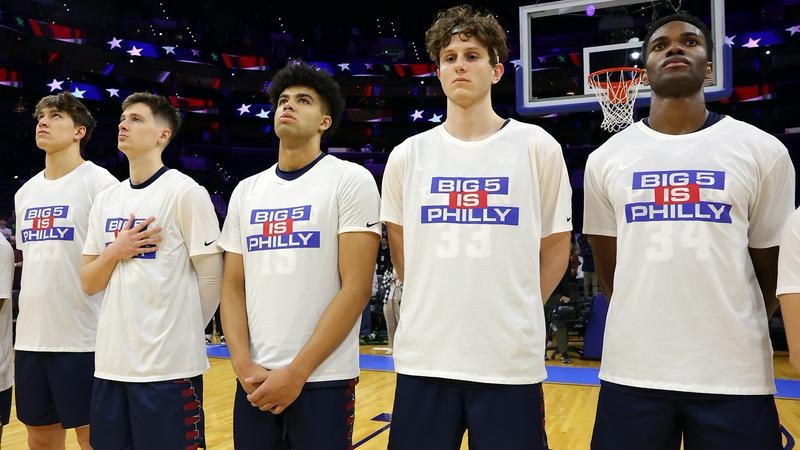
It’s hard to not relate the bigger picture NCAA complications and discussions around the wild west nature of NIL, transfers, and eligibity to our own backyard. At its core, the Big 5 is a microcosm of what makes college basketball special. It’s insular, its cyclical in the sense that it pays homage to the past, and it’s even a little weird. It’s a relic of what the sport was founded on: competition and unique tradition.
“I think the beauty of the Big 5 – as it was and as it can be – the beauty is this.” Martelli said. “Everybody that watches this, at some point, went in their backyard and played whiffleball against their neighbor, their brother, their cousin. If it wasn’t whiffleball and it was cold out, they played knee football in the basement. They played 3 on 3 with guys on their neighborhood and school. As you advance, that’s the beauty of the big 5 – you’re in the yard.”
Still, it’s hard to recognize the Big 5 as we knew it without the illustrious coaches so crucial to it and representative of it.
A guy like Jay Wright, who seemingly had the world in his hands tucked under his tailored suit and cufflinks typically doesn’t just walk away from a perennial powerhouse. It’s head scratching to a point, but makes perfect sense at the same time.
Dealing with agents and worth figures, trying to instill a culture or style with five new guys each on their second, third, maybe fourth team. Continuing the “Villanova Way” with players who aren’t Villanovain and didn’t buy in from the jump. The coaching qualms today are real and persistent, and they’ve obviously had an immediate impact on the success and continuity of these Philadelphia programs.
After Wright’s departure, in came Kyle Neptune to fill the impossible Italian leather shoes of him. After three unpromising seasons, his services were decidedly no longer needed. Billy Lange similarly lept into the shadow of a giant on City Avenue, only to find a similar dilemma on the opposite side of the Holy War. Fran Dunphy, dubbed Mr. Big 5, did all he could to help his Alma mater La Salle through coaching transitions and Steve Donahue struggled to keep Penn afloat only to now somehow get fired into a better job with a better commute at St. Joe’s. Perhaps no Big 5 team had more iconic coaches than Temple – highlighted by John Chaney who probably would not have minced words about the state of affairs in the sport.
The teams in this city rely on coaches. They rely on consistency and culture. These aren’t just buzzwords scribbled on blackboards or fluff for the flock of reporters after losses, they are tangible, and the results speak for themselves.
As Big 5 enthusiasts, we wish the best of luck to all our current coaches in the tradition. Hopefully, this generation can usher in new special moments and new standards to programs that all need it.
 5 features
Leave a comment